
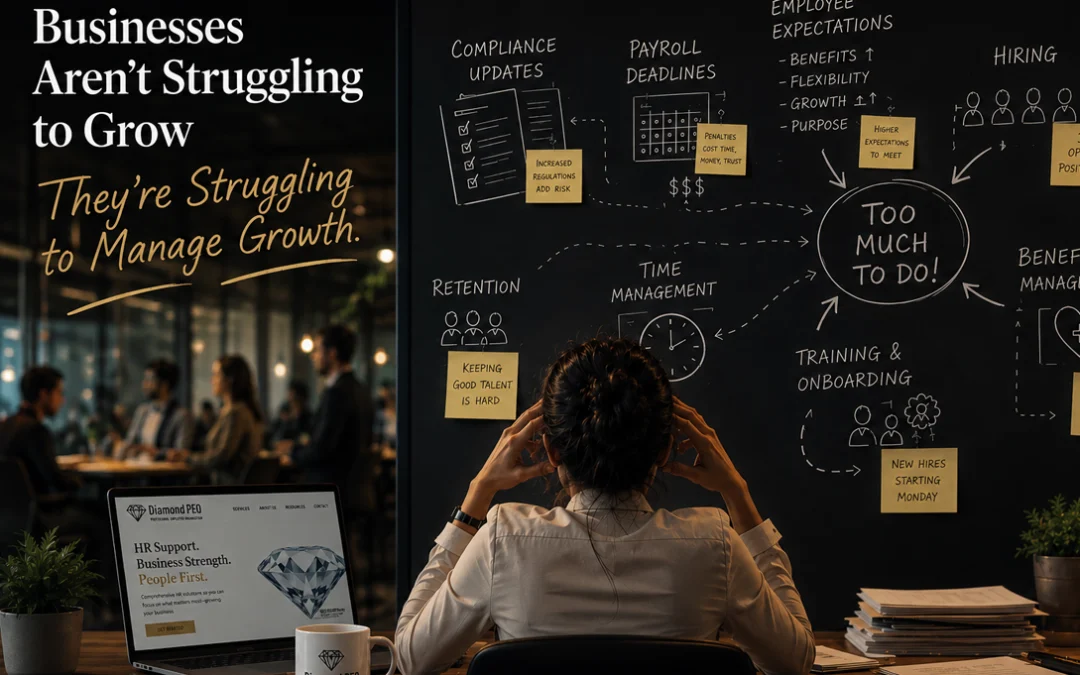
For many business owners, growth used to be the goal. More customers, more employees, more locations, more opportunities. But in today’s business climate, growth often comes with a new set of problems that many companies were never truly prepared for.
Across industries, businesses are discovering that growth itself is not the challenge. Managing that growth has become the real obstacle.
A company hires more employees, and suddenly, payroll becomes more complicated. New labor laws appear. Employee expectations change. Benefits management becomes time-consuming. Scheduling becomes difficult. Compliance requirements increase. Workplace disputes become more likely. The administrative side of running a business begins consuming more time than the business itself.
Many owners are now spending more time managing HR responsibilities than focusing on sales, operations, customer experience, or expansion.
The modern workforce has also changed dramatically in just a few short years. Employees expect stronger communication, faster onboarding, better benefits, flexible workplace policies, and professional HR support. Even smaller companies are expected to operate with the structure and professionalism of much larger organizations.
At the same time, regulations surrounding employment continue evolving. Wage and hour laws, workplace compliance, hiring documentation, employee classifications, and labor requirements are becoming increasingly difficult for businesses to keep up with consistently. One mistake can lead to financial penalties, employee dissatisfaction, or unnecessary legal complications.
This is especially difficult for growing businesses that may not yet have a full internal HR department. Owners often find themselves trying to juggle payroll, onboarding, employee issues, compliance, recruiting, and operations all at once. Eventually, growth starts creating stress instead of opportunity.
That is why many businesses are rethinking how they operate.
Instead of continuing to pile administrative responsibilities onto already overwhelmed managers and owners, companies are turning toward smarter operational support systems that allow them to stay efficient while continuing to grow.
Professional Employer Organizations (PEOs) have become an increasingly valuable solution for businesses seeking to simplify operations without sacrificing growth potential. Rather than forcing companies to build large internal HR departments, a PEO provides access to professional HR support, payroll administration, benefits management, compliance assistance, onboarding support, and workforce guidance under one streamlined structure.
The result is not simply convenience. It is operational stability.
Businesses are realizing that sustainable growth requires infrastructure. Without the right systems in place, growth can quickly create internal chaos. Owners become reactive instead of proactive. Employees become frustrated. Administrative errors increase. Productivity slows. Expansion becomes harder to manage.
The companies that are thriving in today’s environment are not necessarily the ones growing the fastest. They are the ones building smarter systems behind the scenes.
Another major shift occurring in 2026 is the growing importance of employee retention. Hiring alone is no longer enough. Businesses must now focus heavily on keeping quality employees long-term. Competitive benefits, organized onboarding, consistent HR support, and positive workplace experiences are becoming critical factors in employee loyalty.
Employees want to work for businesses that feel organized, stable, and professionally managed. When HR systems are disorganized or inconsistent, employees notice quickly.
Business owners are also becoming more aware of the hidden financial cost of administrative overload. Every hour spent dealing with payroll issues, compliance paperwork, onboarding confusion, or HR emergencies is time taken away from growth strategy, customer relationships, and revenue generation.
This operational fatigue is affecting businesses across nearly every industry, from restaurants and retail companies to medical offices, construction firms, professional services, and growing family-owned businesses.
The reality is simple: modern business growth requires more support than ever before.
Companies that recognize this early are putting themselves in stronger positions for long-term success. They are creating operational systems that allow owners to focus on leadership instead of constantly putting out administrative fires.
As businesses continue adapting to changing workforce expectations, increasing regulations, and rising operational complexity, having the right support structure in place is no longer a luxury. It is becoming a necessity.
At Diamond PEO, businesses gain access to experienced HR, payroll, compliance, and workforce support solutions designed to help companies operate more efficiently while staying focused on growth, productivity, and long-term success.